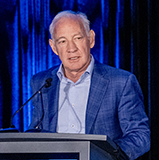
Greg Maffei, CEO, BANN Ventures
Co-Founder and Chair, Horse Racing League (HRL)
Greg Maffei:
Thank you. One of the problems with going last is you may hear a theme or two that you’ve already heard. People have suggested you’ve got to tell people things three times before they get it. Maybe that’ll be the answer. I want to thank The Jockey Club and Everett Dobson in particular for having me here and having my partner, Danny Epstein as well. A year ago, if you’d asked Everett or me whether I would be a keynote for The Jockey Club, I think both of us would have been stunned. So, I’m going to start out with a few stats as I said, then I’m going to tell you a little about HRL. So, we are starting a team-based competition with a season-long championship that will be celebrity and brand owned stables. We will have an always-on digital storytelling presence led by social media. If you’re familiar with F1, obviously an enormous change in how we did things there was drive to survive, which really turned the story around.
Sergio Marchione who ran Ferrari said, “My car is the star.” And we said, “No, this is a story about drivers and about teams and about rivalries, and that’s what you want to build on.” We will have culture-fueled events. We plan to change some betting formats to make them simpler and more accessible. And we plan to address both linear and TV streaming. I would point out that as was noted earlier, YouTube is eating the world. The amount of content and viewing on YouTube dwarfs anything else and it will continue to grow faster and faster. And you need a massive presence on YouTube to be effective. The one thing I can say about HRL, and Everett stole this too, is it’s not for any of you. You guys already know the majesty of horse racing. You know the grandeur, you know the history, the pageantry, the excitement.
We want to reach out and tell it to a bunch of people who either only see it once or haven’t seen it at all.
To misquote Charles Dickens, it is the worst of times by many measures. Some of these have been gone through. Obviously foal crop, number of races, total handle. And total handle is actually misleading because that’s a nominal dollars. If you think about it in real dollars, it’s effectively been nearly halved and you’ve lost massive market share arguably to other forms of sports betting. But it’s also the best of times. The Kentucky Derby, at least one race has doubled its audience and it’s doubled in the time when linear television has been effectively halved. The number of cable households over the last 23 years has gone down dramatically and they’ve grown their presence enormously. Why? The 24 million fans tune in because the Kentucky Derby is an event. How many people tell you, “Oh, I want to go to the Kentucky Derby at least once.” And that’s it.
A lot of them disappear for the rest of their lives or at least for the rest of the year. Horse racing, as it’s been mentioned before, doesn’t have an attention problem. It has a retention problem. And our goal is obviously to change that and build an ongoing relationship with fans that continues. The HRL will be about teams that they can emotionally identify with, follow, cheer on, and bet for. It will be about season-long storylines that unfold before, during, and after the race. In fact, it’s going to go around all year, taking a lesson from what we did with Drive to Survive and building continuity and having a way to stay in touch with people. It was mentioned before that horse racing has a supply problem. I’ll disagree. Horse racing has a demand problem. It doesn’t have enough new fans coming in. I think that’s what we really need.
If you look on the last point about culture-driven content events that bring unexpected worlds together, let me note something. A recent study on USC by USC noted that 50% of young fans are attracted by content outside the sport, whether it be influencers or viral videos or other forms of content that draw them in. And that’s what we need as an industry to reach out to it. And certainly that’s what we’re going to try to do at the HRL.
If you think about it, it isn’t like just buying soap or buying a car or anything else. Today’s fans live the experience of the sport that they’re in. It’s a part of them. I have a friend who worked for me at Liberty who had a whole chapter about how the Olympic system is attached and this is touching them in ways that are meaningful in bond and that are so much deeper than any other kind of relationship.
It has to explain why somebody would be a Jets fan for 20 years.
We hope to engage them in all these ways. The fans that will watch races, follow teams and players, wear the merchandise, have both fantasy and wagers, attend events, debate and create content, the whole experience. And part of that is remembering this is an event, is imagining the race day. Another thing I’ll somewhat disagree with was a comment an earlier speaker that said the race is the product. The whole experience is the product. And that’s what we envision doing. We want fans to come and activate in different ways. Things that we did in Formula 1 that were different were things like running a bunch of F1 cars around Trafalgar Square and having the drivers, when they were told not to, do donuts with their cars all around Trafalgar Square. That’s what attracts attention. We want a differentiated food and drink experience. There are premium experiences, but there are also different experiences, and we hope to do that.
And most of all, we want to bring in relevant culture and interspersed entertainment with no downtime. So much of what happens at a race is down and then there’s the race and then there’s a down period. These younger fans want to be engaged all the time. At Formula 1, we couldn’t get the younger fans to watch an hour and a half race. They watched the 10 minutes on YouTube. We want to take the whole two hours that is the HRL day, and I’ll explain a little more of the format in a minute, and make it continuously something exciting. Two-minute race, music, something else happening. Storytelling, something else happening. We want to keep it going the whole time. We also want to bring in star power and celebrities as has been mentioned before. That same USC study showed that 80% of younger fans attend events, not only for the event itself, but for celebrity sightings, for the food, for the experience, for the whole cultural event.
The race is not the only product.
One of the things that I always find very hard, and what I’ve pulled up as a prop when we’re talking about the HRL on videos, is the betting form that shows you how to bet at a lot of these tracks. If you’re not familiar with it, it looks like you’re trying to design a nuclear weapon. It is not a simple product. It is not something that’s easily accessible for fans who are not familiar with it. And we hope to simplify that with new formats. We’re developing our own rating system based on Equibase for horses, and we’re going to use that in new ways and hopefully find new betting formats. If you look, for example, I was recently involved in FIFA and off. I can talk about that another time. The World Cup generated 75 times more volume than a typical MLS game. Obviously, there was massively more attention to it.
It was a cultural event that people wanted to be a part of, and they weren’t necessarily soccer fans. And the proof of that perhaps is also in that simplified betting. Amazingly, more people bet on whether Ronaldo would cry than bet on who would win the golden boot. Stunning, the golden boot is the high scorer through the tournament.
The road of the HRL, let me tell you what we’re doing. We announced ourselves in July. We are going to have more announcements in October when we announce some of our celebrity team principals. I’ll talk more about the race schedule, but first to note, we are going to have a combine where the horses will be inspected and they’ll do some breezes. And then in November, we’re also going to have a draft. The league will have 80 horses that we own that are drafted by the 10 teams. We will also have jockeys be drafted. So, one of the interesting questions will be where do you rate the horse versus where do you rate the jockey?
We’re going to race at some of the most iconic venues available. And I want to thank Aidan and Joe Longo and Shannon for putting up with all of our crazy thoughts and ideas and some of the things that we’re talking about creating. The league format, to give a little more detail, is we will have 10 teams. We will sell four or five. The remainder will be independently operated with racing managers and celebrities attached, we hope. We’ve sold to some of the leading stables already like WinStar, and you should expect more announcements in the coming weeks. Our first year, we’ll have three events. I mentioned the tracks already. We expect to grow to six events over time at additional tracks. And we are having productive discussions with some of those now. Four races on each of our days, there’ll be a six-race undercard, but our four races will be two on turf and two on dirt. And we will hand out $10 million the first year, $5 million in purses, and $5 million based on how the teams finish through the season.
Our stable of talent, we’d like to think as I’ve mentioned, you’ve got myself here, Danny Epstein, my partner in the room. We brought Renee Wilm, who came with me from Liberty and really set up the first F1-owned race in Vegas and has a ton of learnings from that. Clifford Lidell who joined us from Complex Media, exciting branding we have. And we have a new CMO we’re going to announce shortly in the next day or two who’s joining us from one of the league leading movie studios. We’ve already hired eight people on our way to 25 and we have our creative agency. We have our agency, which is helping us with sponsorship and with ticketing.
We are certainly aware of some of the industry’s drives and challenges, and we are committed to delivering a safe racing experience, not only for the benefit of the horses, but also because we believe that’s what fans want. So, we’re racing at some of the safest tracks. The structure of how our teams are set up with backup horses, with only having four events and eight horses suggests we’ll always be available without issues on the horses. And we’re committed to some of the leading aftercare organizations with donations planned both by the teams and the league to TAA and PDJF.
So, I started out by telling you this wasn’t for you. That having been said, we need you. This is one industry. This is one group that needs to work together. We think we can be helpful. We obviously would like to see the HRL be a success for our own reasons, but we think we can be helpful to the whole industry.
And working together, whether it be jockeys or fans or trainers or tracks or regulators or horsemen, we can make not only our three days of racing with four events on each day, but the 365 days of the year more effective for horse racing. Thank you very much.
|