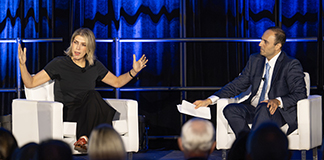
Dan Tordjman:
All right. Well, I know a lot of people are looking forward to this portion of the programming. Marketing is always a hot topic. I’m personally thrilled and excited to welcome in Tor Edwards from the Frankie Jean Group, which, by the way, was named after Tor’s daughters. Frankie Jean is a New York-based company advising leaders on brand, marketing, growth, and transformation. Let’s give it up one more time for Tor.
So simply said, Tor, you help companies build marketing that moves culture and that delivers business results. Tor’s two-decade career spans the U.S., Europe, Asia, and Australia. Tor was most recently global chief creative services officer at HP. Before that, she was president of the award-winning global advertising agency Mekanism with senior roles at 72andSunny and BBDO. Along the way, Tor has helped build some of the world’s biggest brands, including major sports and entertainment properties like Adidas, the NFL, Google, Amazon.
And my personal favorite as my wife who’s in the crowd will attest, Fanatics. I love Fanatics.
So, Tor, you do bring a rare combination of business acumen, creative fluency, and a deep understanding of the challenges that, specifically, legacy institutions face when they’re trying to scale. We’re fortunate to have you with us here today. And I’ll speak from the perspective of America’s Best Racing, which I know well.
So, you’ve heard some of the numbers earlier in the programming. Our biggest growth levers over the past couple of years has been in social content and influencer marketing. We’ve generated 300 million video views, a billion impressions last year, massive numbers. This year, aided by that viral video of Cherie losing her mind winning the Kentucky Derby. We’re up in video views 166%. Influencer marketing that we’ve done around ownership has driven millions and millions of new people to the idea of ownership. So, from where you sit, what do those numbers tell you about racing’s ability to move people? And how have you seen this kind of momentum scale across other brands that you’ve worked with?
Tor Edwards:
Ooh, good question. First and foremost, I think that kind of viral video, there is a reason for that. People, the sport aside, connect with emotion. Human visceral reactions, the good, the bad, the ugly. People want to see those emotions. And I think that’s why it transcended into culture – of audiences and cohorts that have never really participated in horse racing – because they connected to that moment and that story. And I think that’s what great modern brands do, is they find ways to connect. And you see how that works across multiple heritage brands, including, you talked about Fanatics. Fanatics do an incredible job regarding the swag, the entertainment, the events, the storytelling, the people. They talk about all of these activities around the actual activity itself, and it brings everyone into that moment. So, it becomes bigger than the brand at those moments.
Dan Tordjman:
Absolutely. Well, with that in mind, that’s a great way to tee all of this up. For the next 15 minutes, you’re going to present the role that marketing can play in racing’s next era, why it matters, and how to connect with the new growth audience. After that, we’ll come back and we’ll do a question that came in from people watching on social media.
Tor Edwards:
Awesome. All right, let’s just hope this clicker works. I’m super excited to talk to you all today about modern marketing, fandom, and the opportunity for growth.
I’m not going to belabor this slide. We all get it. Handle’s declining. Got an aging audience. There’s fewer foal crop and attendance is slipping overall. Not just that, there is more competition than ever. You’re not just competing against other sports. You’re competing with the Saturday, Sunday brunches, the group chats, the gaming, the coachellas, the events, the TikTok spirals. There is more competition than ever.
Here’s the beautiful thing. You do not have an overall product problem. People know you exist. Twenty-four million people watch the Derby. That is not a product problem. They know you are around, but it is clear you have an access and an engagement problem. Racing can get a hot date, but they cannot stay in a committed relationship.
You are getting ghosted.
Thanks for the little chuckles.
We conducted a national audience survey of 25 to 45 year olds. Five cities, New York, Los Angeles, Miami, Houston, and Chicago. Fifty/fifty men and women, casual bettors, race goers, non-race goers. And it was really fascinating some of the results that we received. The absolute overall theme was that they know horse racing exists, but they do not know how to access it. They don’t know how to engage, and they do not see it pop up in their world. They are not rejecting the sport, but it is totally absent from their consideration set right now. Also, it was quite interesting because I know it’s a topic and it’s very important, but no one brought up horse safety as a barrier, as a concern.
But what are the opportunities? Look what happens when the moment there is an on-ramp, dressing up, fashion, understanding the bet, seeing content that shows up on their platforms, that feeds and fuels their interests. Nobody in this survey, nobody, needed convincing. They needed inviting in a way that speaks to their wants and speaks directly to them. I’m going to call this new growth audience the player and the story follower, two particular audience profiles that we really want to dive into. Twenty-five- or even 20- to 45-year-old is the most commercially valuable audience in American entertainment and sport. Every brand, every league, every platform, and every experience is fighting for them. Horse racing just has never seriously competed for them at scale. This is the opportunity. So who are these people? First is what we’re calling the player. Skews male, came up on fantasy. It’s fluent in spreads, draft picks, same-day cup, parlays.
He’s in the group chat with all his mates arguing about a pick, sending screenshot when it lands, taking the abuse when it doesn’t. The wager is part of his social life. They gamify it. This is why he’ll spend 15 hours on a fantasy team and 10 minutes watching the actual game. A sport he cannot play, bet, or argue about with his friends is a sport he cannot follow. There is huge opportunity here to make it entertaining, socializing, gamifying what betting’s like. Then we have the story follower who skews predominantly female, 60/40. This audience enters sport through narrative rather than the actual competition itself. They find new sports through docu-series, long-form podcasts, behind-the-scenes content, athlete-led storytelling. They will binge watch an entire series of sport they have never seen live, and then they’ll book a trip to see it the next day. They care about character arcs, rivalries, tensions, drama, struggle, origin stories, and the humans inside the sport. It’s like reality TV to them. They want to see it all.
Narrative-led sports unlock audiences that competition-led marketing has never reached. Real talk. You have more raw material than any other platform. You have it. We just got to make sure it is the right material being directed in the right way at them. To win, we need to show up where they are with their energy and give them new ways to engage with the sport.
Okay. Let me talk to you a little bit about their behaviors. TikTok, YouTube. By far the primary discovery for this audience. TikTok is the most used social platform among Americans 35 and under. YouTube reaches 84% of Americans monthly. It is now the single largest platform. Streaming and clips. Over half of this audience say highlights and reaction clips, little 10-second bursts, are replacing live games for them. Streaming is nearly 50%. Streaming. Nearly 50% of all U.S. TV time. Broadcast is 19%. Cable is 20%. Streaming is now bigger than both of those put together. This is where they are.
Second screen. Don’t know if any of y’all do this, but 77% of fans do something else when they’re watching sport. They’re checking their stats. They get their phone out. They’re talking on Reddit. They’re on social media. They’re looking at another game. Their fantasy, they’re betting. Gen Z and Millennials drive this second-screen experience.
Creator and athlete channels. Again, not new news, but they follow people, not networks. They feel a stronger personal connection to social media creators than to TV personalities or actors. Podcast, long form video. Again, nearly 70% of these audiences listened to a podcast last month. YouTube is the number one podcast platform. They are there constantly.
Spanish language. I thought this was really interesting with all the data: 72% of Hispanic sports fans are Millennial or Gen Z. This audience, they love it. They love sport. They love to bet.
Gaming and fantasy. We talked about it. But half of this audience, half of fantasy content increases their sports engagement.
Personality wins. You’re going to hear a lot of this as well throughout my talk. This audience wants to laugh. They want to be entertained. They want to be invited in a world that they love. There’s a reason why Bravo and Housewives are so popular. They want to have content that they can then share out. Serious kind of creative doesn’t necessarily resonate with them.
I think this is a great quote: 29% of users or stats, excuse me, became more interested in sport after watching a content about it in TikTok and 28% discovered new sporting events through TikTok content. Now I can’t see you all because of the lights, but put your hand up here if you have a TikTok account. Aidan, I can’t see you, but I know you definitely do. This is not about you. I will guarantee your sons, your daughters, your nieces, the next door neighbors, your friends of your friends, they all do. A national marketing program is about connecting to them. The goal of this is to get your kid to come up to you and go, “Huh, look what I just saw on my socials.” That’s awesome. That is who we’re talking to. That is what we need to deliver. Again, we talked about this, but the fastest growing sports in the world create content that audience want to participate in. Create a led, socially native, entertaining, energetic, vibrant, something they can participate in, not just watch.
And so here’s the kind of – the playbook. Modern sports closes the distance between fan and the sport. Horse racing must do the same. Here are the three kinds of pillars. The stars, the stories, and the moments. The stars – make the characters famous, not just the sport. The stories – run an engaging content all year long. Keep them in a committed relationship. Don’t lose them on that first hot date. We need to continue talking to them and engaging them 365 days of the year and make the moments. You capture attention by capturing emotion and imagination. And you convert attention by giving fans something to do, not just watch. I talked about this before, and Charlotte and Everett probably heard me say this, but I feel like if Formula 1 had and golf had a baby, that would be horse racing. The history, the tradition, the ceremony of one, the speed, the visceral emotion, energy, and excitement of the other.
That is horse racing. That is why we can sell this to this new audience. That’s what they want.
How are we going to do that? All right, closer to the stars. If modern marketing is built on characters, not calendars, we need to turn our people and our unique athletes, the horses, into characters our audience can connect with in culture. I thought this was really interesting. It blew my mind actually: 16.1 million posts on TikTok, Thoroughbred. Over a billion bilzillions on TikTok for horses. For horses of TikTok, for Girl Talk. There is a whole world out there that are talking about these athletes. There is a whole interested media that are discussing this. We just got to tap into it.
Closer to the stories. Modern sports aren’t just competition. They’re cultural storytelling engines. Entertainment platforms. We need to make the sport a daily cultural presence, not just a three-day event. This sport has money, drama, fashion, celebrities, music, dynasties. It is the most exciting and unbuilt storyteller engine in American sport.
Closer to the moments. If stars give people someone to love, stories give them a reason to care. Moments give them reason to show up. Every growing sport has learned the same lesson. You capture attention by capturing emotion and imagination. You convert attention by giving fans something to do, not just something to watch. We need more can’t miss moments. We need to lower the barrier to stepping inside them. Watching, showing up, and yes, betting. Marketing is not just nice to have. Advertising is what you buy. Marketing is what you build. It is something you can measure.
It is long term. And what it builds is a generation of people who watch, who turn up, who spend, and who will stay. Everett, I kind of stole some of your words and paraphrased it a little bit, but I think you said it long before I did. Fan engagement drives handle. Handle drives revenue. Revenue will drive industry growth. It will allow you to stand the test of time.
Dan Tordjman:
That was absolutely awesome, Tor. The through line was engagement, right? Generating engagement. And on theme with that, we figured we would engage with people on social media. So, we did a poll. We asked them what it was about horse racing that got them hooked and what they would do to hook other people. And the things they mentioned, we’ve touched on throughout the programming today. Talking about movies, digital content, prominent horses, games like Umamusume, family members at the track, but not through traditional marketing efforts.
So final question of the day. How does the national campaign, this one right here, meet fans where they’re already falling in love with racing rather than trying to build a new funnel from scratch?
Tor Edwards:
I mean, firstly, I don’t think you are building a new funnel from scratch. They know you exist. You’re just not in the consideration set. We have to be in their minds, their worlds. They are there. And everything that question asked kind of nails it. It’s what we’re talking about. We don’t need to do traditional TV campaigns to connect with this audience. That’s not what they want to say. We need to connect with them in those non-traditional ways, social, digital, earned media, partnerships, creators, things like that to convert them. They’re on the peripheral. They know horse racing’s a thing. It’s not like you’re starting from scratch where you have to tell people you have a product. You just have to get them involved. You have to do it in the way that’s non-traditional, that’s their world. Again, so that they can then come back to you and say, “Oh my God, did you do this?”
Dan Tordjman:
Absolutely. Well, look, I expect your phone and your email to be blowing up over the next few days. Tor Edwards, everyone.
|