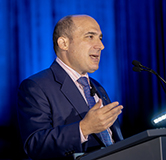
Joe Appelbaum, Co-Founder, Off The Hook / Founder & CEO, Waigr
Joe Appelbaum:
Thank you. Good morning. I’d like to take you back to Travers Day 2001. A horse named Dr. Kashnikow, trained by John Kimmel, splits horses, storms on to win the Fourstardave. Completed a Pick six for my friends and I. There was a lot of celebrating as you can imagine. But as we jumped around the Saratoga backyard with this kind of Runyonesque cast of characters, I never imagined that this wager, this particular wager would lead to my horse ownership, eventually owning 200 horses, opening a training facility called Off The Hook that welcomed over 800 horses through our gates, including 50 stakes winners, two Breeders Cup champions. I’ve won Grade ones, I’ve won five claimers. Nothing, I mean nothing, I enjoy more than winning a horse race. Well, maybe a Knicks championship. I’ll set that aside, but I think you get my drift. This picture that you’re seeing is the same crew celebrating a horse that we own called Poet Warrior.
We’re in the backyard. We had it broadcast to us in the backyard in Saratoga, but he’s down at Timonium winning a $6,000 non-winners-of-two-life, going seven furlongs, but down there that’s three turns.
But most days in August to this day, you’ll still find us sitting under those same trees. Yet today, while my involvement in the business side of the sport has grown exponentially, my participation as an owner is a shadow of what it once was. So let’s jump ahead to March 2026, 25 years later. I’m pondering my dearth of horses. When I realized what originally drew me to this sport, it’s not the competition, although that’s great. It’s not the horses who I learned an amazing amount from. I started as a urban cowboy. And it wasn’t even the gambling anymore.
It was our friendship. It was the thing that brought us together to socialize. And our horses started to run more infrequently and that gave us less opportunities to socialize. So, I thought to myself, are other owners thinking like I do? Now, a normal person might grab a coffee, go to the backstretch here, talk to some owners, see what people are thinking. But I, when I tend to be confronted with these questions, go back to statistics. So with the help of two Yale Bulldogs, Dean Schaffer and Donovan McKoy, we started digging into the statistics that describe the ownership experience. As you can see, if you’ve been paying attention over the last two decades, you’ll not be surprised to find that the headline participation numbers are not what they once were. In the past 20 years, our overall ownership is down 46%. And this leads directly to parallel declines in horse and trainer population.
The data strongly suggests that there’s a simple demand story here. But when we dive deeper into the data, we see a much more nuanced pattern of supply and demand mismatch. And I want to talk, before I dive in, I want to talk about some themes that you heard from Charlotte. You’ll hear from me, and I think you’ll hear from speakers later. They’re themes about retention, about matching supply and demand, and about who we’re actually competing against. And you’ll see these things repeated not just here, but with other speakers. One thing, the first question I get when I show these numbers is people say, “Well, what about the syndicates?” So Dean and Donovan did a tremendous amount of work parsing out who’s an individual owner, who’s a partnership owner. We don’t have a view into the syndicates, but I’ll get to that in a little bit.
So, this is owners that we’re calling recognized owners that are outside of syndicates. The first thing we need to know beyond this headline number is that the decline in ownership is not uniform. The largest share of the Exodus is attributable to racetrack closures. It’s simple. When the regional tracks shutter, we’re losing a majority of the owners, period. Beyond the closures, poor retention is deeply entrenched. It’s a long-term structural crisis. It’s not new. Obviously, it accelerated after the 2008 financial crisis, but the cumulative effect is becoming harder to ignore. And you can see these graphs. If we could go back one, sorry. This is where our losses are outstripping our gains in ownership. So obviously we want to recruit more people than we lose, just like any business. And this is showing this is not new. This has gone on for a while, but something that needs to be addressed.
The metric though that really stands out for me is the steepness of the exit curve. It really looks like a power law. In one year, 39.4% of our owners walk away, new owners. By year five, we lose 79.2%. One thing, and we’ll get back to it in a little while, is once owners stay for five years, they tend to stay with us for a while. So that’s like a benchmark maybe we should be shooting for. Often, we console ourselves by proclaiming that our most prominent states are doing just fine. And a cursory look at the top line data does indeed show that they’ve bucked the trend. But if we look closer, the large state retention numbers are often worse than the national averages. Our most prominent tracks maintain their ownership ranks, which are high by creating attractive environments for new owners and absorbing owners from the shuttered tracks.
A small but sizable number is buttressing them. As an aside, this wasn’t part of the original speech. I met a lovely couple in the paddock yesterday and they find Saratoga enthralling. And of course it is. So, some of this that I’m going to talk about with the owner experience may not resonate with all of us because we’re the ones who are here. We’re the ones who love it. We’re the ones who are invested for year over year over year. But it doesn’t make the arguments less true for those who are not with us. At first glance, it appears owners are telling us the product we are offering — owning and racing a Thoroughbred — is simply not competitive with other sport and leisure activities. But what they’re really telling us, and this comes through, is that they’re willing to pay a price for a premium experience. And our question is, is our sport willing and able to deliver that experience?
Why do I think this? There’s really two reasons. The first is economics. Horse racing is distributing more money per start and per horse than we ever have. Owning a racehorse has always been a speculative financial endeavor, but in relative terms, the economics are better today than ever. Despite this, despite this, owners are voting with their feet. It’s not to quote James Carville, to reverse quote them, it’s not the economics.
Anecdotally, syndicates appear healthier than the overall ownership pool. Why is that? Yes, some will say they offer a more digestible entry point. True. But their biggest advantage is the experience they offer. By design, the individual in a syndicate trades a portion of her financial return for an enhanced experience. Just look at their commercials. Syndicates are selling access, expertise, camaraderie. They’re proving that owners are willing to pay a premium if you give them community, communication and an insider’s view. And this data, as I was saying before, doesn’t just show us the problem. It also suggests some ideas for the future. If we can get that owner to stick around beyond five years, they’re going to stay with us a while. But the challenge is how do we move people to the right-hand side of that curve? There’s some clear evidence of what works. First off, starting with more horses is a strong indicator that an owner will persevere.
Whether it’s a share in multiple horses or outright ownership of a bunch, diversification is good. Owners who start with midsize trainers also tend to last longer than those who gravitate at first to the largest and smallest trainers. And counterintuitively, but if you’ve been listening unsurprisingly, on-track financial success in year one is a factor, but not a particularly strong one. We want to find those people who can commit for a while. There’s also a supply side story to tell. We have a horse scarcity problem at just those points of the year when owners want to participate the most. Everyone wants in at the same meets. Last week, my old friend Jimmy Ferraro won a 24-way shake. So what does that tell me? It tells me there’s 23 unfilled orders out there. And what are we doing to fill those orders? This is a matching problem. It’s actually an excellent opportunity to do some work.
We want to run at meets where people want to be at. Owners will pay for that experience. We’re literally watching them compete for the chance to participate. Can we as a sport meet our customers where they are and when they want to be in? This is a question for all of us. We need to find ways for owners to enjoy themselves without what they might consider a burdensome commitment. They’ll pay for the privilege. Our deep past in Standardbred racing may have one solution - seasonal horse leases. We should provide the means for people to participate while keeping ownership in the hands of a breeder or some entity that can serve as a longtime steward of the animal. It shouldn’t be considered a lesser form of ownership, but one that sized to what people are asking us for. This is one idea. Maybe it’s part of the solution.
There’s bound to be others, but good ideas don’t implement themselves. A seasonal lease means a horse may change hands more. On paper, how do we do that over eight weeks as opposed to a lifetime? Can our state licensing processes handle this? Who registers silks for a horse that’s just theirs till Labor Day? Do our horsemen’s bookkeepers have enough resources to keep up with all the smaller checks they may need to write? Or has it become such a hassle it becomes undoable? The sport, let’s be honest, has been slow to adopt far smaller asks than this. For example, despite years of widespread availability, it took the creation of HISA for the implementation of electronic medical records to be standardized. Are we dynamic enough to adapt our infrastructure for needed change? Another implementation conundrum is this question: Whose problem is this and who is really supposed to fix it?
Is it individual trainers? Racetracks? Horsemen’s organizations? Sales companies? The Jockey Club?
The answer is every one of those and all of us, but yet none of us are really focused on it. Currently, our sport relies on ad-hoc groupings to put out fires, launch initiatives. This approach, kind of rooted in the old state by state regulatory regime, has proven to be reactive in a poor response to the competition we face. No amount of cajoling, goodwill or even collegiality constitutes a strategy. Let me suggest some baby steps that The Jockey Club could possibly spearhead. First, we need to survey our lapsed owners. We need to understand why people leave the sport. All right? That’s the first thing any business would do. Secondly, The Jockey Club has a vast treasure trove of data to drill into the supply and demand matching problem. Providing answers to riddles like these will go a long way to tooling other participants to act.
If we’re content with our niche status, we can end the discussion quite honestly. However, there’s a possibility for a brighter future, but we need to compete. We compete fiercely on track, but when the competition is other sports, other entertainment options, our response has not been up to par. We act as if the competition is Saratoga versus Del Mar, TwinSpires and Xpressbet. It isn’t. A real competition is hanging in Berckmans Place at the Masters, a fractional ownership in a European football club, a Wheels Up membership, or maybe a lake house for your grandchildren to enjoy.
At this point of the speech, I’m going to repeat something that’s been repeated up here many, many times before. I’m not naive, but it doesn’t make it untrue and it needs to be said again and again. To meet the challenge, to meet the modern challenge of sports and entertainment, creating a forward-looking, sustainable decision-making and action structure is imperative. Racetracks, horsemen, racing commissions, individuals, all of us need to sacrifice a little bit of autonomy for the greater good. I know it’s not an easy ask. I know there’s decades of jobs and commissions and committees built up, and no one enjoys losing any authority, but a cohesive apparatus is necessary. This is exactly what happens in other sports, in particular racing sports. NASCAR has a single sanctioning body that sets the rule book that every team follows. Formula 1, I wrote this before I knew who was speaking later, operates under the Concord Agreement where teams seed commercial and regulatory authority to the FIA.
But I’d like to return to a core truth here. The owner attrition rates are really telling us that owners are willing to pay a premium price for a premium experience. Is our sport willing and able to deliver that to them? Improving the ownership experience is a test of our leadership and our culture. Like many of you, I was raised on this game in the 1980s. I’m often nostalgic for an era when it was more plentiful, more celebrated, more culturally relevant. But times have changed. Who’s willing to step up, craft systematic solutions, and convince our peers and colleagues to join in? No one’s coming to save our sport. The solutions are in this room. They’re in racing offices. They’re within tack rooms. It’s on us. The situation reminds me of a favorite Ben Franklin quote of mine: “We must indeed all hang together, or most assuredly, we shall all hang separately.” I’d like to thank The Jockey Club for giving me this platform.
A special thanks to our chair, Everett Dobson, as well as Jim, Charlotte and Jamie for jumping on numerous Zoom calls with me. They challenged my numbers. We made them better. They challenged my thinking, and I think it really honed what I wanted to say. There’s nothing quite as enabling as a strong critique. But really in the end, this is what we’re trying to protect and promote. Not a business model, not a regulatory structure, not a foal crop. It’s the pure joy of a young man jumping around with his friends in the backyard when he wins a race. Thank you all. Have a great day at the races, hopefully.
|