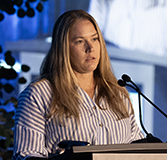
Kristin Werner, Vice President, Thoroughbred Strategy and Industry Initiatives, The Jockey Club
Kristin Werner:
Thank you. Good morning, everyone. Three years ago at the Round Table Conference, I introduced The Jockey Club’s Traceability Initiative. When we talk about traceability, we’re talking about understanding what happens to Thoroughbreds after they leave racing or breeding. Racing’s the easy part. We’ve got a lot of information where horses are actually actively participating in the industry. The challenge comes when horses move on to a second career, private ownership, retirement, or other paths. The question isn’t just where are our horses? It’s how can we do a better job of staying connected to them throughout their lives? Traceability matters because people want to know what happens to Thoroughbreds after racing. That includes horse owners, aftercare organizations, regulators, racing fans, the public, and plenty of others. The more information we have, the better we can understand outcomes, identify gaps, and focus resources where they need to make a difference. It also helps us to move the conversation from speculation to data.
Over the past three years, we’ve added several new tools to improve traceability, including a traceability survey, digital certificate prompts, and the ID My Thoroughbred app, which was launched earlier this year. There’s no single source that tells us where every Thoroughbred ends up. So we’ve taken information from a lot of different places. This includes registry and breeding records, T.I.P. and Retired Racehorse Project participation, horses associated with TAA-accredited organizations and CARMA and the new traceability tools. Each source provides a piece of the puzzle. So, when combined, they give us a much clearer picture of what is happening to horses after racing and breeding. I also want to thank Dr. Jill Stowe from the University of Kentucky who has helped us with this analysis. Through all available data sources, we were able to establish a traceability connection for approximately 60% of Thoroughbreds born between 2008 and 2023. This includes horses that are in race training or appear in registry records or breeding stock exported, reported as died, and reported through the Traceability Initiative.
Many horses that aren’t showing up in racing or breeding records can still be found through other sources. Of the estimated population of Thoroughbreds from 2008 to 2023, of more than 376,000 horses, around 46,000 are in racing today. Nearly 17,000 were accounted for in TAA and CARMA. 26,500 were accounted for in T.I.P. and RRP with over 3,000 horses accounted for in both aftercare organizations and sport horse programs. By introducing new outreach efforts, we were able to identify horses that wouldn’t have appeared in traditional records alone. Many of these sources rely on voluntary participation and self-reporting, which highlights the importance of continued engagement. Just as importantly, it helps us to identify the populations where additional traceability efforts are most needed. A lot of the traceability reach challenges we identified appear to be related to visibility, not necessarily horse welfare. Horses with more connections to industry programs, owners who submit accurate and timely records and horses captured through mandatory reporting systems were easier to trace.
In many cases, we’re not losing the horse. We’re losing track of the information. The data showed that some groups of racehorses were harder to trace than others at the end of their racing career. So, when I talk about risk factors here, I’m talking about the risk of losing visibility of a horse. It doesn’t necessarily mean that the horse has had a poor outcome. Geldings and colts were a higher risk population than fillies and mares. We also saw increased risk among horses leading lower-level racing, claiming races and maiden races. Horses competing for lower purses and older retired racehorses. The jurisdiction of a horse’s last race may also elevate or lower risk with horses having a last start at a racetrack covered by HISA at a lower risk than horses with a last start at an uncovered track. That’s something that we will continue to explore with industry stakeholders.
On the breeding side, mares with production record, sales histories, and ongoing commercial activity were generally easier to trace. Visibility drops significantly for mares over the age of 16 due in large part to gaps in registry reporting. Mareworthy recently discussed similar findings from its domestic broodmare population analysis, and we look forward to continuing to collaborate with them on future efforts. Taken together, these findings give us a roadmap for where visibility breaks down and where future resources can have the greatest impact. The good news is this data gives us some clear direction on where to focus. We’re continuing to expand owner and stakeholder outreach through the aftercare liaison program and other direct contact efforts. We’re looking at ways to improve reporting when horses leave racing or breeding, to strengthen follow up opportunities and to make better use of tools like the digital certificates, Thoroughbred Connect, registry reporting, and the ID My Thoroughbred App.
We’re also continuing to support organizations and programs that help horses successfully transition into their next careers and evaluating additional funding mechanisms. The goal isn’t to know where every horse is every day. The goal is to reduce the blind spots and improve the understanding of what happens after racing and breeding. As we continue this work, I’d encourage you to take a look at the resources available through The Jockey Club for planning a Thoroughbreds next career. This QR code links to information on responsible retirement placement options and other available programs. And if you have questions, ideas, or information that you’d like to share, we’d love to hear from you. Feel free to reach out at traceability@jockeyclub.com. At the end of the day, the more connected that horses stay to owners, to organizations, and to industry resources, the easier they are to trace and the better position that we are to support them throughout their lives.
Thank you very much.
|